



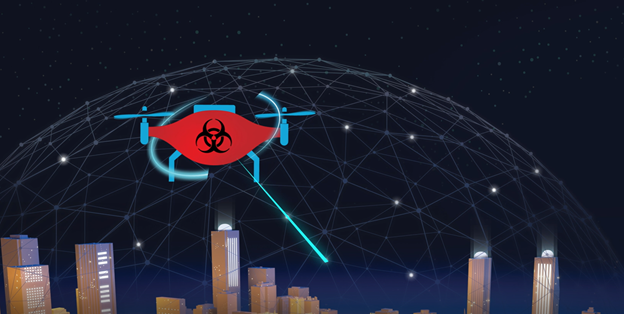
There was a time—not long ago—when the world trembled before an unseen enemy. Streets fell silent, cities became graveyards of movement, and the human breath itself was feared. The era of COVID-19 had turned existence into isolation, and survival into a daily negotiation with death. Today, that invisible terror has not disappeared; it has merely changed its form. The virus has evolved—not biologically, but politically—into the buzzing wings of drones over the skies of the Middle East.
From Wuhan to Washington, humanity once counted cases. Now, from Tehran to Dubai, it counts explosions.
The ongoing conflict between Iran and the United States has redefined the geography of fear. What was once a medical emergency has now been replaced by a mechanized apocalypse. In cities like Dubai—long considered islands of stability amid regional chaos—the illusion of safety has been pierced by the cold precision of drone warfare. Iranian retaliatory strikes, largely aimed at U.S. interests in the Gulf, have increasingly spilled into civilian spaces, disrupting airports, igniting fires, and shaking the psychological foundations of modern urban life.
In March 2026, drone strikes near Dubai International Airport caused fires and forced flight diversions—an eerie reminder that no skyline, however glamorous, is immune to the shadows of war. Elsewhere, debris from intercepted drones struck buildings, leaving behind not just physical damage but an emotional residue of vulnerability. The message is unmistakable: the battlefield is no longer confined to borders; it hovers above them.
This transformation from virus to drone is not merely symbolic—it is existential.
The coronavirus thrived on invisibility; so do drones. The virus spread silently through breath; drones glide silently through the air. Both instill fear not just through destruction, but through unpredictability. One attacked the lungs; the other attacks the nerves. One isolated individuals; the other isolates nations. In both cases, humanity finds itself trapped in a state of suspended anxiety—waiting, watching, and wondering where the next strike will come from.
But there is a deeper irony.
During the pandemic, nations closed their borders to protect life. In war, they open fire across borders, endangering it. The same technological advancements that once accelerated vaccine development are now being used to refine instruments of destruction. The laboratories of healing have given way to the laboratories of war.
Dubai, once a symbol of globalization and economic resilience, now stands as a metaphor for the fragility of modern civilization. A city built on the promise of the future finds itself haunted by the politics of the past. The drone hovering above its skyline is not just a weapon—it is a question mark hanging over the idea of progress itself.
Meanwhile, the conflict continues to escalate. Despite weeks of sustained attacks, Iran retains significant missile and drone capabilities, underscoring the prolonged nature of this confrontation. The persistence of aerial threats indicates that this is not a fleeting crisis, but a new phase in global warfare—one defined by technology, asymmetry, and psychological dominance.
If COVID-19 taught humanity the value of breath, this war is teaching it the value of silence—the silence of skies that are no longer peaceful.
The world once prayed for a vaccine. Today, it silently prays for de-escalation.
For in this new era, the enemy does not cough—it hums. It does not spread through touch—it strikes from above. And unlike the virus, which humanity eventually learned to fight, the drone represents a far more complex challenge: a fusion of technology, politics, and power that cannot be quarantined.
History will remember this transition—not just as a shift from pandemic to war, but as a transformation in the very nature of fear.
From breath to buzz, from virus to drone—the world has not healed; it has merely changed its wounds.