



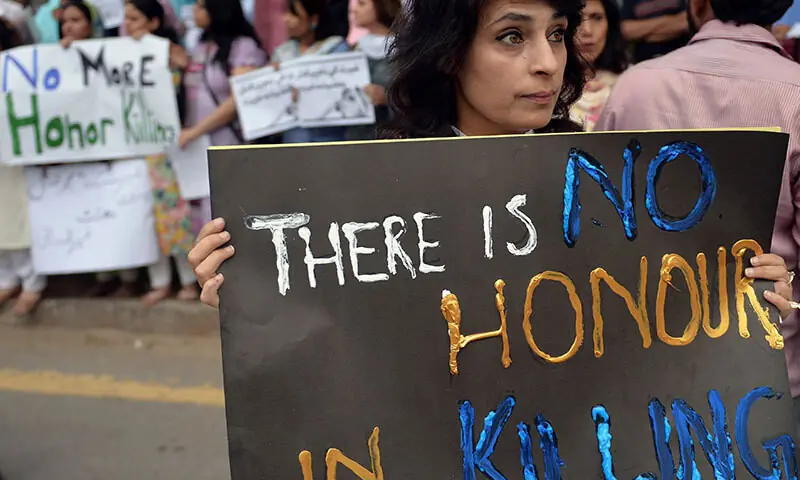
Sindh continues to face a deeply disturbing and persistent form of gender-based violence known as honor killing. Despite legal reforms, awareness campaigns, and increasing media coverage, the period from 2022 to 2026 shows that the crisis is not declining but structurally embedded in society.
The available statistics from the Sindh Police, Human Rights Commission of Pakistan (HRCP), Sustainable Social Development Organization (SSDO), and media monitoring reports reveal a consistent pattern of violence, with women forming the overwhelming majority of victims.
Between 2022 and 2026, honor-related killings in Sindh have remained above alarming levels. According to Sindh Police data reported in media investigations, approximately 114 people were killed in 2022, including around 89 women. In 2023, the number rose sharply to nearly 167 cases, showing a clear escalation in violence. The year 2024 recorded approximately 152 killings, while 2025 emerged as one of the most disturbing years, with around 162 deaths in the first ten months alone, most of them women. Early monitoring reports from 2026 indicate that the trend has not significantly declined, suggesting continuity rather than improvement.
At the national level, the Human Rights Commission of Pakistan (HRCP) reported 405 honor killings across Pakistan in 2024, with Sindh identified as one of the most affected provinces. The Sustainable Social Development Organization (SSDO) 2024 report further highlighted that thousands of gender-based violence cases were registered in Sindh, yet conviction rates remained extremely low, in some districts close to zero. These findings demonstrate that the issue is not only the occurrence of crimes but also the lack of effective justice delivery.
The gender dimension of this crisis is undeniable. Across all years, women account for nearly 70 to 80 percent of victims, and most killings are carried out by close family members such as fathers, brothers, husbands, or sons. This reveals that honor killing is not a random act of violence but a deeply rooted mechanism of patriarchal control over women’s choices, mobility, and autonomy.
In many cases, victims are targeted for choosing their own partners, seeking divorce, or even based on unverified allegations about social interactions.
Underreporting further complicates the situation. Human rights organizations consistently argue that official statistics represent only part of the reality. Many cases are disguised as suicides or accidents, while others are settled privately within families to avoid legal consequences or social stigma. This means the actual number of women killed in the name of honor is likely significantly higher than reported figures.
Structural factors continue to sustain this crisis. One major cause is the persistence of patriarchal norms, where women are considered carriers of family honor. In rural Sindh, feudal power structures also play a significant role, where influential landlords often override formal legal systems. The presence of jirgas (tribal councils) further complicates justice, as these parallel systems sometimes legitimize or excuse such killings. Weak law enforcement, political pressure, and lack of witness protection contribute to poor conviction rates, reinforcing a culture of impunity.
Another disturbing aspect is the misuse of the karo-kari concept, which is often presented as a cultural justification for honor killings. However, research shows that it is frequently used as a tool to settle personal disputes, land conflicts, or family rivalries. In such cases, accusations of “dishonor” become a pretext for violence rather than a genuine moral concern.
The human cost behind these statistics is devastating. Each number represents a life lost, often a young woman whose future is abruptly ended. Many victims remain unnamed in official records, buried in silence and stigma. Activists have described this as the existence of “graveyards of dishonor,” where victims are buried without proper funeral rites or public acknowledgment. This erasure of identity adds another layer of injustice to an already brutal crime.
Efforts to address the issue have been made at the legal level, particularly through the Criminal Law (Amendment) Act 2016, which attempted to close loopholes allowing family forgiveness in honor killing cases. However, enforcement remains weak, and compromise settlements continue in practice. As a result, perpetrators often escape meaningful punishment.
Civil society organizations, including HRCP and local women’s rights groups, continue to demand stronger action. Their key recommendations include making the state the complainant in all honor killing cases, ensuring fast-track courts, strengthening police investigations, and protecting witnesses. They also emphasize the need for long-term social reforms through education, economic empowerment of women, and awareness campaigns challenging patriarchal attitudes.
In conclusion, the period from 2022 to 2026 clearly shows that Sindh’s honor crisis is not an isolated phenomenon but a structural and ongoing social issue. Despite laws and reforms, the continued rise and persistence of honor killings reflect deep-rooted cultural norms, weak institutional response, and systemic inequality. Without strong enforcement, judicial accountability, and social transformation, women in Sindh will continue to remain vulnerable to violence committed in the name of honor.