



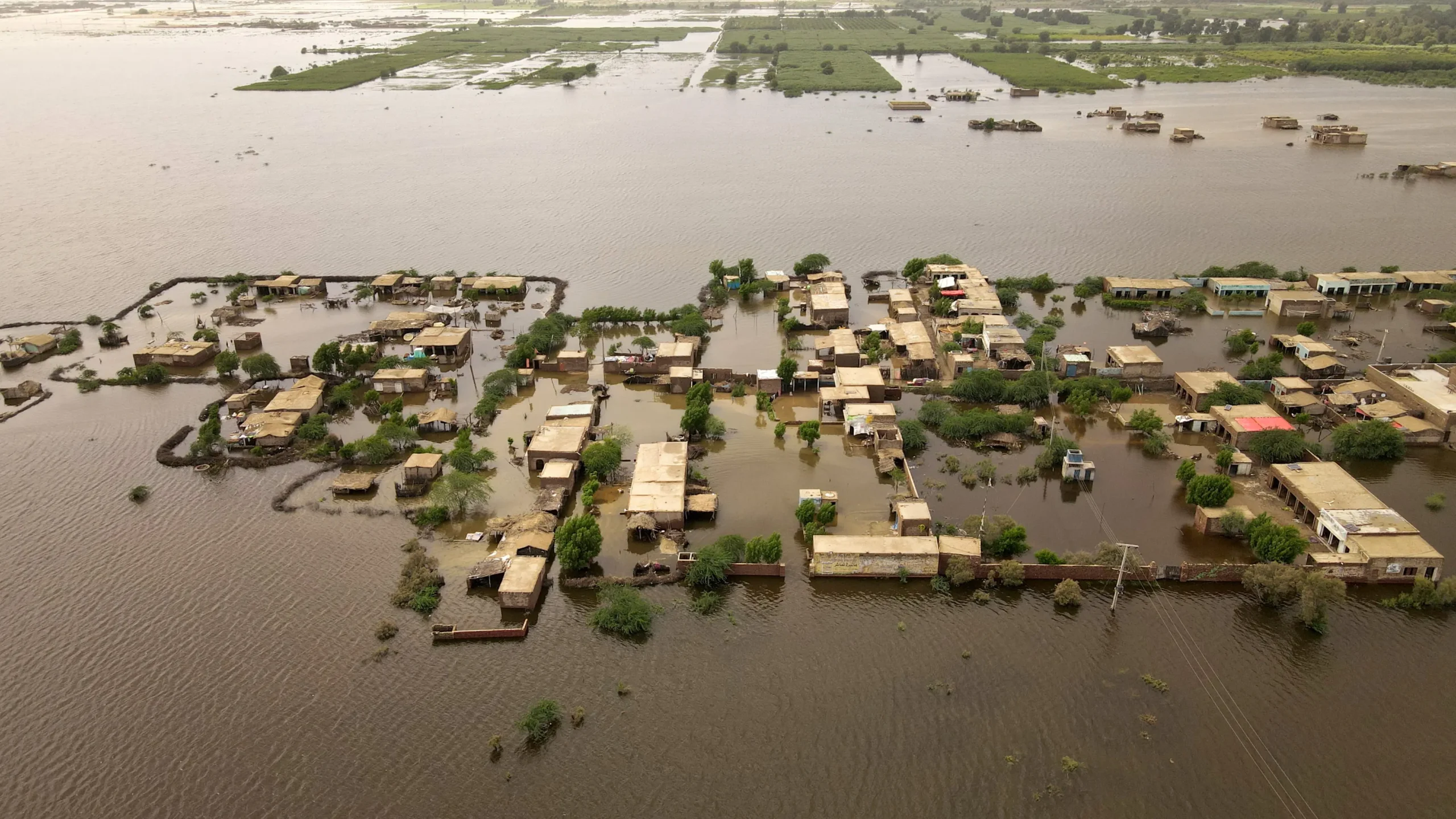
Farmers affected by Pakistan’s devastating 2022 floods have announced plans to file a climate justice claim against major global carbon emitters, arguing that the disaster exposed the country’s extreme vulnerability to climate change despite its minimal contribution to global emissions.
Speaking at a press conference at the Karachi Press Club on Thursday, farmer claimants Hamza Khan Kalhoro, Abdul Hafeez Khoso, and Abdul Khaliq Leghari—representing Larkana, Jacobabad, and Dadu—said the floods had destroyed crops, livestock, and homes, pushing thousands of farming families into prolonged economic hardship.
They said Pakistan contributes less than one percent to global greenhouse gas emissions, yet continues to suffer disproportionate losses from climate-induced extreme weather. According to the farmers, historically high-emitting corporations must be held accountable for climate-related losses and damages, as affected communities bear the cost while polluters continue to profit.
The farmers announced that 43 cultivators from Sindh are preparing to file a legal claim against two major historical polluters in Germany—RWE and Heidelberg Materials—seeking compensation for losses suffered during the 2022 floods.
Nasir Mansoor, leader of the National Trade Union Federation (NTUF), described climate change as both a livelihood and labour rights issue. He said repeated climate shocks were eroding rural employment, threatening food security, and deepening inequality due to the absence of climate-resilient policies.
He noted that Pakistan is among the regions most severely affected by climate change, pointing out that nearly 14,000 glaciers across three mountain ranges are rapidly melting, while around 90 percent of the historic Indus Delta has already been lost. Mansoor said the current industrial development model had pushed the planet to the brink, calling the farmers’ legal action a timely and historic step toward climate justice.
Dr Shaikh Tanveer Ahmed of the HANDS Welfare Foundation said the 2022 floods were not merely a natural disaster but a direct consequence of global warming. He stressed that farmers were paying the price for emissions they did not produce, driven by unchecked industrialisation, deforestation, and fossil fuel use.
International solidarity partners supporting the claim said climate litigation was increasingly being used worldwide to seek accountability where political responses had failed. Miriam Saage-Maab, a German constitutional lawyer and representative of the European Centre for Constitutional and Human Rights (ECCHR), said the case aims to amplify the voices of flood-affected Pakistani communities in international legal forums.