



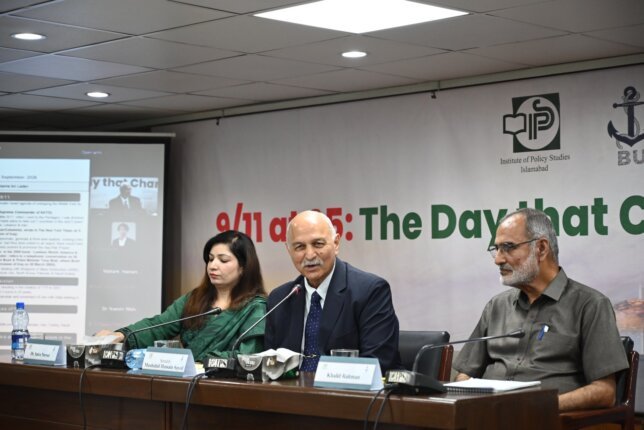
Islamabad: The September 11, 2001 attacks fundamentally changed global politics, reshaped the international security environment, and triggered a prolonged “War on Terror” whose consequences continue to influence international affairs, speakers said at a seminar in Islamabad.
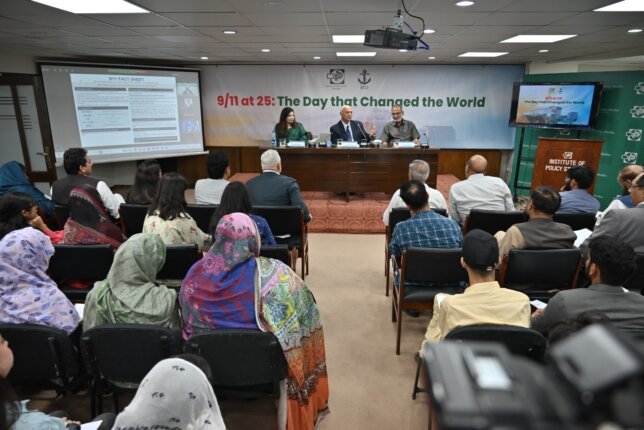
The discussion took place during a guest talk titled “9/11 at 25: The Day that Changed the World,” organized by the Institute of Policy Studies (IPS), Islamabad, in collaboration with the Department of International Relations at Bahria University, Islamabad.
The event featured Senator Mushahid Hussain Sayed, chairman of the Pakistan-China Institute; Khalid Rahman, chairman of IPS; and Dr. Saira Nawaz Abbasi, head of the Department of International Relations at Bahria University.
Delivering the keynote address, Mushahid Hussain argued that 9/11 and the subsequent U.S.-led military response significantly altered the global balance of power and contributed to changes in the post-Cold War international order.
He questioned whether the U.S. response to the attacks was proportionate and argued that the post-9/11 environment was subsequently used to pursue broader geopolitical objectives.
Referring to strategic debates that preceded the attacks, including the Project for the New American Century, he discussed how ideas surrounding military intervention and regime change had influenced sections of U.S. strategic thinking.
Mushahid Hussain also highlighted the human and financial costs associated with the wars that followed 9/11.
Citing Brown University’s “Costs of War” project, he referred to estimates of around $8 trillion in U.S. expenditure related to the post-9/11 wars, alongside extensive loss of life and the displacement of millions of people.
He argued that the inability of military interventions to achieve all of their intended strategic objectives demonstrated the limitations of military power and contributed to changes in American global influence.
Discussing Afghanistan and Pakistan, Mushahid Hussain described the post-9/11 period as particularly consequential for the region.
He argued that political arrangements established in Afghanistan following the U.S. intervention did not sufficiently account for the country’s historical and social realities. He also said Pakistan experienced significant security and political consequences, particularly in the former Federally Administered Tribal Areas (FATA).
Mushahid Hussain further pointed to the expansion of Indian influence in Afghanistan during the period of the U.S. presence as another important regional development.
Turning to changes in the wider international system, he contrasted U.S. expenditure on military operations with China’s emphasis on infrastructure development and economic connectivity during the same period.
He argued that these different approaches contributed to China’s growing international influence.
He also referred to Russia’s re-emergence under President Vladimir Putin and the growing significance of Muslim-majority middle powers, including Pakistan, as indicators of an evolving international system.
Mushahid Hussain identified Islamophobia and anti-Muslim prejudice as another major consequence associated with the post-9/11 era.
He discussed the growth of right-wing political movements in parts of the West and said contemporary tensions should also be understood within their broader historical and geopolitical context.
He stressed the importance of distinguishing factual developments from propaganda when examining relations between Muslim societies and the West.
Speaking at the event, IPS Chairman Khalid Rahman said the declaration of a “War on Terror” represented a major shift from treating terrorism primarily as a criminal matter requiring investigation, prosecution, and judicial proceedings.
Rahman argued that one of the most serious consequences of the post-9/11 response was the weakening of the international legal framework. He emphasized the continuing importance of the United Nations and international law in addressing global conflicts and security challenges.
Dr. Saira Nawaz Abbasi discussed 9/11 from the perspective of international relations and securitization theory.
She said states can frame particular issues as security threats through political discourse to advance domestic and international objectives.
Referring to the response of former U.S. President George W. Bush following the September 11 attacks, she discussed how political communication contributed to framing the attacks as a broader national security issue.
The seminar examined the geopolitical, legal, economic, and societal consequences of 9/11 and the subsequent “War on Terror,” while assessing changes in the international system over the past 25 years.